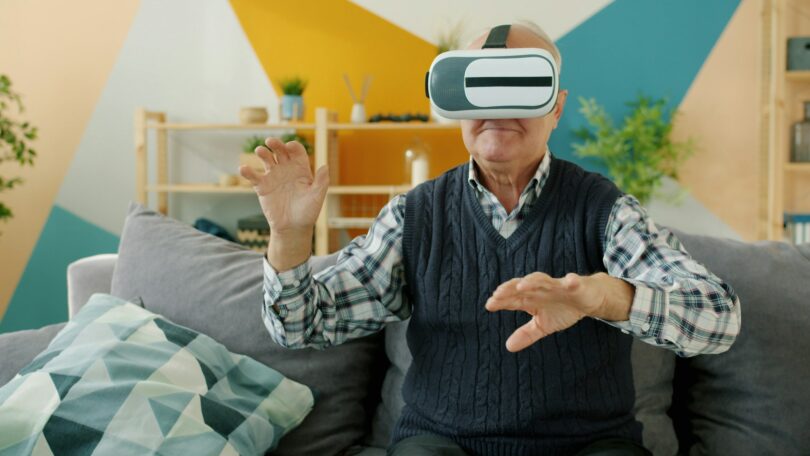

Charley Locke reports for the New York Times on how virtual reality can take people to places they’d only ever dreamed of visiting. And, it can take communities of people on the same journey, allowing them to bond over their virtual travel experiences. Whether it addresses social isolation is an open question.
At one senior living facility, a social service worker guided residents with virtual reality goggles strapped to their heads through a trip to Santorini, Greece. The social service worker pointed out fortresses and other sites, inviting people to talk about what they enjoyed most about their trip. It’s not clear why this experience would do more to address social isolation than watching a film.
No question, social engagement is key to giving life more meaning and extending life. Social isolation can have serious health consequences and can lead to premature death. It can also increase the risk of dementia by 50 percent and stroke by 32 percent.
Locke reports that virtual reality technology works well for older adults, especially if they are unable to move easily. Certainly, the manufacturers of the virtual reality programs are hoping to return profits based on the notion that virtual reality addresses social isolation and brings people closer together. It’s unclear to me though whether a good conversation at a senior living facility led by an engaged speaker wouldn’t deliver the same outcome.
The argument for virtual reality is that it takes you to a different place, bringing joy and wonder and generating robust conversation. (It also doesn’t tire you out!) But, why doesn’t a movie that takes place in some exotic venue do the same?
Research out of Stanford University suggests that virtual reality can affect mood and people’s interest in connecting with others. It can take you on a hike on a sunny day. You can see the flowers and the birds, even if you can’t smell them. And, it’s immaterial that you might hate hiking!
Some also claim that virtual reality could reduce health care costs. It could help with pain management and anxiety at home so that people don’t need to visit a clinic for treatment. Again, there’s no good data behind the claim. But, there’s some evidence that virtual reality can ease social anxiety and some phobias.
If it’s a no-cost journey, virtual reality is worth a try. It could be enjoyable. But, I wouldn’t invest in it as a means of combating social isolation.
Here’s more from Just Care:
- Can virtual reality help people with depression?
- Why social health is as important as physical and mental health
- Feeling isolated? Look into virtual communities
- Poll: Health care concerns rank high, embedded in concerns about immigration, government and the economy
- Improve your health with a buddy