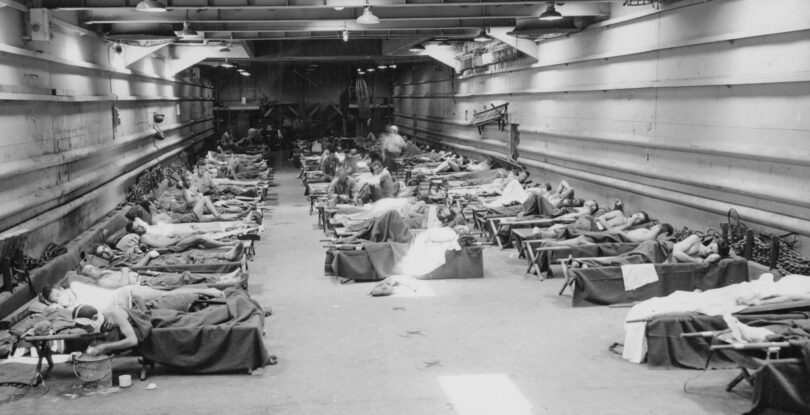

In a piece for KFF Health News, Elisabeth Rosenthal describes the harrowing experiences her husband faced in a hospital emergency room, while suffering from esophageal cancer. It got to a point in the last months of his life that he refused to go to the emergency room. Rosenthal set up a hospital in their home to care for him.
Rosenthal, a trained physician, worked to keep her husband’s blood pressure at appropriate levels, and otherwise relieve his discomfort, allowing him to rest and sleep. For Rosenthal, care at home for her husband was better than watching him lie in a hospital emergency room space on a stretcher for what could be days waiting for a hospital room.
But, then in the middle of the night, she found herself unable to treat him successfully and called an ambulance. She could not treat the fluid build up in his lungs, his shortness of breath, and persisting coughing.
It was the summer of 2024 in New York City, and her husband, Andrej, became delirious. She did not know whether he had an infection or his cancer had metastasized to his brain. After two days in the ER downstairs, the hospital moved him to an “overflow” understaffed emergency area, with a man in a coma and a woman in only a diaper and boots, on the first night. Rosenthal moved him the following day to a room with two other people, both of whm died over the next three days.
It’s now not unusual for people, particularly older adults, to spend more than 24 hours in a short-staffed hospital emergency room. They call it ED boarding. In Andrej’s case, hospital staff were overworked and not meeting his needs. They served him chicken when he could only eat soft food. They did not change his dirty sheets. They instructed Rosenthal to do so.
And, our government has done nothing yet to ensure adequate nursing care and, more generally, patient safety, in hospital emergency rooms. Instead, hospital administrators who are focused on managing costs, do what they can to reduce them, even when it puts patients at risk. Admitting inpatients from the emergency room appears not to be in their financial interest. They get the same reimbursement for keeping patients in the emergency room as for getting patients a proper bed and room, even though boarding in the emergency room costs less.
Apparently, “overbooking” is in the financial interest of the hospital administrators. They want to be sure that every inpatient bed is full. So, they have fewer beds than they often need. And, they want patients who have elective procedures, such as hip replacements and heart catheterizations, in these beds because the hospitals generate more revenue from them.
Moreover, giving an elderly person a bed as an inpatient could mean keeping them for an extended period, without pay. They often cannot be discharged home. And moving them to rehabilitation facilities can involve long waits because beds are hard to come by.
Not surprisingly, a government report found that “Emergency department (ED) boarding is a public health crisis in the United States.” They say that “Patients who are sick enough to require inpatient care can wait in the ED for hours, days, or even weeks.” “Boarding contributes to increased mortality, medical errors, prolonged hospital stays, and greater dissatisfaction with care.”
The Trump administration cut back on HHS resources, so HHS has not taken this issue on. But, in 2028, hospitals will be required to report ED boarding times. Until then, only those people with access to VIP treatment can be assured admission to a proper hospital room, with a proper bed and bathroom and a nurse on call.
Here’s more from Just Care:
- Avoid private equity-owned hospitals
- Hospitals increasingly opt out of Medicare Advantage networks
- Emerging data reveal high ER death rates at private-equity owned hospitals
- Choose your hospital emergency room carefully
- Round up: Emergency care